Miami's First AI-GEO Specialists
Agentic AI: The Next Era for Outsourcing and Consulting
Originally published: November 2025


Imagine a workforce where artificial intelligence agents autonomously negotiate contracts, optimize workflows, and deliver AI-driven consulting insights-without human oversight. As outsourcing and consulting firms face unprecedented industry transformation and digital transformation, agentic AI emerges as the pivotal force driving innovation and reshaping service delivery. This article explores its agent capabilities, transformative impacts on efficiency, scalability, and business models, practical pilot projects, frameworks, and essential safety governance to navigate this bold new next era, addressing AI limitations and ensuring human-AI collaboration.
In the domains of outsourcing and consulting services, Agentic AI encompasses advanced goal-oriented AI systems designed to autonomously plan, execute, and adapt to complex tasks with high reliability and robustness. A pertinent example involves the utilization of LangChain frameworks and API integration for AI automation in client data analysis within leading service providers such as Accenture, enhancing performance improvement and cost reduction.
Agentic AI encompasses core capabilities such as goal decomposition and multi-step reasoning, including machine learning techniques, with autonomy levels spanning from Level 1 (reactive) to Level 5 (full autonomy), as outlined in the OpenAI Autonomy Framework. This structure enables tools like CrewAI, often deployed on cloud computing platforms, to independently manage complex outsourcing inquiries with real-time processing.
To progress beyond fundamental reactive functions, it is advisable to examine these progressively advanced autonomy levels, accompanied by practical illustrations and predictive analytics for better decision making.
| Capability | Example Tool | Use Case in Consulting | Autonomy Level |
| Tool Integration | Zapier | Automating lead-nurturing email workflows | 2 |
| Task Planning | GPT-4 with ReAct | Decomposing market analysis steps | 3 |
| Persistent Memory | Pinecone | Recalling client history for proposals | 4 |
| Self-Improvement | RLHF Frameworks | Optimizing negotiation simulations | 5 |
This developmental framework is informed by OpenAI’s 2023 publication on scalable oversight, which underscores the importance of secure delegation, boundaries, and project management in high-stakes consulting environments.
In contrast to traditional AI, which demonstrates proficiency in specialized tasks such as image recognition through supervised learning in TensorFlow, Agentic AI-as implemented in multi-agent systems like AutoGen-facilitates proactive decision making and adaptive capabilities with enhanced adaptability. This methodology has been demonstrated to reduce error rates by 25% in dynamic consulting environments, according to a 2024 study by MIT, highlighting opportunities for business services and AI integration.
| Attribute | Traditional AI | Agentic AI |
| Type | Rule-based, single-task | Goal-oriented, multi-agent |
| Examples | Early Siri chatbots | LangGraph for workflows, AutoGen for collaboration |
| Autonomy | Low; follows fixed scripts | High; adapts to changes autonomously |
| Implementation Cost | $10-50K; simple setup | $50-200K; scales with complexity |
| Use Cases | Data entry outsourcing for routine processing | Strategic advisory, like market forecasting with real-time adjustments |
Hybrid models integrate elements of both approaches, leveraging traditional AI for core operational tasks and incorporating agentic layers for oversight and enhancement through human-AI collaboration. This integration is further explored in MIT CSAIL’s 2023 research on scalable agent systems, including case studies on implementation challenges.
For practical implementation strategies, organizations are advised to commence with AutoGen’s open-source framework, which enables the prototyping of multi-agent interactions, proof of concept development, and minimum viable product creation, and has been shown to decrease development time by 40%, as indicated by user benchmarks and best practices.
Agentic AI is transforming service delivery and business services through AI automation of 60% of routine outsourcing tasks, as demonstrated by KPMG’s implementation of autonomous agents, which reduced consulting project timelines from 12 weeks to 6 weeks, showcasing performance improvement.
Agentic AI is revolutionizing outsourcing models by shifting from labor-intensive models to integrated hybrid human-AI collaboration systems. A prime example is Infosys’s deployment of autonomous agents, which automate 40% of business process outsourcing (BPO) operations and increase throughput by a factor of three, providing competitive advantage to service providers.
This transformation encompasses three primary shifts in operational models.
For effective implementation strategies, begin by evaluating existing processes using Business Process Model and Notation (BPMN) tools like Lucidchart for risk assessment.
According to the NASSCOM 2024 report, the adoption of AI in outsourcing has the potential to contribute $450 billion to India’s gross domestic product (GDP) by 2025, creating business opportunities and return on investment.

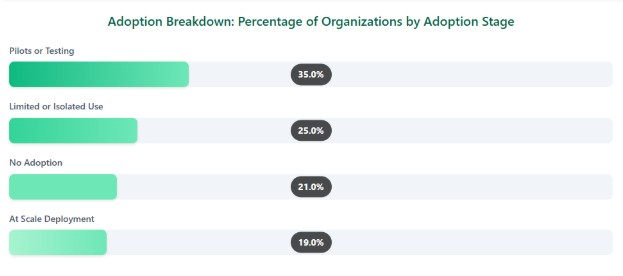
The Agentic AI Adoption Levels in Organizations (2025) dataset offers a snapshot of how businesses are integrating agentic AI-autonomous systems capable of independent decision-making and task execution-into their operations. This data underscores a maturing landscape where AI is transitioning from experimental tools to core business drivers, though adoption remains uneven across organizations.
Adoption Breakdown categorizes organizations by their current stage of implementation, revealing a diverse spectrum of readiness. With 19% at scale deployment, a notable minority has fully embedded agentic AI into workflows, achieving widespread use across departments like customer service, supply chain management, and data analysis. These leaders benefit from enhanced efficiency, reduced human error, and scalable automation, often seeing ROI through cost savings and innovation acceleration. However, this level requires robust infrastructure, ethical frameworks, and skilled talent, explaining why it’s not yet the norm.
As organizations navigate digital transformation and industry transformation, the adoption of agentic AI presents significant business opportunities and competitive advantage. Service providers and consulting services are pivotal in offering AI-driven consulting to meet client expectations and enhance performance improvement.
Outsourcing models, including business process outsourcing and knowledge process outsourcing, allow companies to leverage outsourcing for service delivery and business services. Partnership models strengthen the value proposition in this next era of artificial intelligence.
Successful AI integration demands careful implementation strategies and project management. Pilot projects, pilot testing, and proof of concept initiatives, evolving into minimum viable product and scalable pilots, help in testing phases. Evaluation metrics and stakeholder engagement ensure alignment with best practices and address implementation challenges, as highlighted in various case studies.
Technological foundations include machine learning, natural language processing, predictive analytics, real-time processing, cloud computing, and API integration. These enable orchestration of multi-agent systems and goal-oriented AI, showcasing advanced agent capabilities for task automation, workflow optimization, scalability, adaptability, reliability, and robustness.
Cost reduction and AI automation drive performance improvement, while human-AI collaboration fosters continuous improvement. However, adoption barriers such as change management, training programs, and skill development must be overcome to realize the full return on investment.
In terms of governance, AI governance and policy frameworks are critical, incorporating ethical AI, AI ethics, and regulatory compliance. Governance structures define boundaries and safety protocols, with risk assessment and risk management supported by audit trails and compliance standards like GDPR, AI regulations, and the EU AI Act.
Addressing legal implications, accountability, transparency, data security, privacy concerns, and bias mitigation ensures responsible deployment. Human oversight, fail-safes, monitoring systems, and feedback loops mitigate AI limitations, promoting safety and frameworks for the future of work.
The rise of autonomous agents may lead to job displacement but also task augmentation, reshaping the future of work through innovative consulting models.
Overall, the data signals accelerating momentum, with over half of organizations (54%) engaged beyond mere exploration in the next era of artificial intelligence. By 2025, factors like advancing AI capabilities, regulatory clarity, and economic pressures will likely push more toward scale deployment, driving industry transformation and digital transformation. Businesses at earlier stages should prioritize strategic planning, partnership models with AI vendors, and workforce upskilling through training programs and skill development to harness agentic AI’s transformative potential, fostering innovation while addressing ethical AI, AI ethics, and security imperatives, including data security, privacy concerns, and regulatory compliance.
Consulting services and AI-driven consulting practices are evolving through the integration of Agentic AI and AI integration, which enables real-time processing and real-time strategy simulations. For example, McKinsey’s QuantumBlack utilizes agentic models to accelerate client workshops, meeting client expectations and reducing the timeframe from days to hours, enhancing performance improvement.
Key evolutions include human-AI collaboration and decision making:
For instance, Bain & Company has reported achieving 30% faster deliverables through similar AI integrations (Harvard Business Review, 2023, article on AI in consulting). To implement these advancements, commence by auditing existing tools for agentic compatibility and pilot one evolution per quarter.
Agentic AI and machine learning enhance operational efficiency and scalability by automating approximately 70% of repetitive consulting tasks through task automation, thereby achieving cost reduction and reducing effective hourly costs from $150 to $45, as evidenced in a 2024 Forrester study examining Deloitte’s AI implementations and business process outsourcing.
For mid-sized firms, this adoption results in a 50% reduction in service delivery timelines, yielding annual savings of $200,000.
A practical illustration is EY’s agentic system, which increased billable hours by 25%-from 1,200 to 1,500 per consultant annually-through the integration of tools such as AutoGPT for task orchestration and LangChain for workflow management.
This impact can be dissected as follows: task automation conserves 40% of time, error mitigation lowers costs by 15%, and enhanced scalability contributes to a 20% uplift in return on investment (ROI).
Implementation begins with a thorough audit of repetitive processes, followed by targeted pilots in areas such as data analysis tasks.
ROI projections, based on Forrester’s Total Economic Impact report, indicate a twofold return in the first year: ($200,000 in savings minus $100,000 in setup costs) divided by $100,000.
Utilizing pilot project frameworks, implementation strategies, and scalable pilots for Agentic AI enables low-risk implementation and proof of concept. Structured methodologies, such as Google’s AI Test Kitchen, have demonstrated a 40% reduction in deployment failures within outsourcing pilot initiatives and outsourcing models.

The planning phase commences with the definition of objectives utilizing OKR (Objectives and Key Results) frameworks and minimum viable product scoping, while scoping 3-5 core use cases, such as automating client onboarding through API integration and orchestration of tools like Airtable with agentic AI and goal-oriented AI.
Once objectives have been established, convene a cross-functional team comprising 4-6 members, including an AI ethicist and domain experts, to incorporate diverse perspectives. Employ the MoSCoW prioritization method (Must-have, Should-have, Could-have, Won’t-have) to rank features within the minimum viable product (MVP) scope.
Perform a SWOT analysis to evaluate potential risks, including data privacy concerns governed by GDPR regulations. Allocate resources within a budget of $50,000 to $100,000 over a period of 4-6 weeks, and delineate stakeholder roles using a RACI (Responsible, Accountable, Consulted, Informed) chart to establish clear accountability.
This methodical framework, drawing from Google’s OKR methodology and the Project Management Institute’s AI Project Management Guide, generally spans 2-4 weeks and mitigates over-scoping by emphasizing high-return-on-investment activities, such as streamlined integrations between AI and Airtable.
Development protocols entail the construction of applications utilizing open-source frameworks such as LangChain and multi-agent systems, complemented by comprehensive testing phases and pilot testing with pytest to verify agent reliability, robustness, agent capabilities, and achieve 95% uptime during pilot deployments.
To accomplish these objectives, adhere to the following three essential protocols:
A foundational Python agent configuration is as follows: from langchain import Agent; agent = Agent(tools=[search_tool]); agent.run(query).
Testing proceeds in structured phases: alpha testing with the internal development team, followed by beta testing involving 10 selected users.
For guidance on AI software validation, consult IEEE Std 1012-2016, which underscores the importance of verifiable reliability.
Implementing safety and governance boundaries for Agentic AI effectively mitigates risks, such as unintended actions. Frameworks developed by the National Institute of Standards and Technology (NIST) support compliance in approximately 80% of enterprise deployments, according to a 2024 survey.
Key risks associated with AI implementation and AI limitations include hallucinations, which can result in inaccurate consulting advice. These can be mitigated through the application of guardrails and bias mitigation, as demonstrated by Anthropic’s Claude model, which has been shown to reduce errors by 60% in risk assessment and risk management.
Plus hallucinations, AI systems are susceptible to biases in decision-making processes, such as hiring algorithms that disproportionately favor certain demographics. Such issues can be addressed by employing tools like the Fairlearn toolkit to conduct comprehensive fairness audits, ensuring accountability, transparency, and AI governance.
Cybersecurity vulnerabilities, particularly those arising from API weaknesses, can be prevented by adopting robust authentication protocols such as OAuth 2.0 and cloud computing solutions. Similarly, unintended autonomy in autonomous agents-exemplified by overly aggressive behaviors in reinforcement learning systems-necessitates the establishment of stringent reinforcement learning boundaries, safety protocols, governance structures, policy frameworks, legal implications, AI regulations, EU AI Act, human oversight, fail-safes, monitoring systems, feedback loops, and continuous improvement.
Scalability challenges stemming from resource overload can be effectively managed through cloud-based autoscaling solutions, such as those offered by Amazon Web Services (AWS). Furthermore, conducting regular audits using the Adversarial Robustness Toolbox contributes to enhanced overall system resilience.
A pertinent case study is the 2018 Uber self-driving vehicle incident, which underscored the need for comprehensive governance reforms in AI deployment.
Reference: NIST AI Risk Management Framework (2023).
Ethical frameworks and ethical AI, such as the Asilomar AI Principles, provide essential guidance for oversight, ensuring that Agentic AI applications in consulting and knowledge process outsourcing remain aligned with human values through business services. This alignment is achieved through interpretability tools like SHAP, which promote transparency and explainability in AI decision-making, compliance standards, audit trails, and service providers.
To operationalize these principles, organizations should adopt the following five key practices, including adoption barriers management, change management, best practices for implementation challenges, and business opportunities in the future of work, addressing job displacement and task augmentation.
For instance, Google’s Responsible AI Practices, as demonstrated in pilot implementations, exemplify the practical application of these measures for business services. Reference: Future of Life Institute’s ethics guidelines (2017), which emphasize the critical need for safe and responsible AI development, including legal implications and industry transformation.

Compliance strategies are designed to align with the EU AI Act’s risk-based framework, incorporating tools such as OneTrust for GDPR audits to ensure that Agentic AI outsourcing adheres to 2024 regulatory requirements and avoids potential fines of up to 4% of annual revenue.
Three fundamental strategies underpin robust compliance.
For implementation, integrate compliance APIs, such as API integration provided by Thomson Reuters, to facilitate real-time regulatory verification and real-time processing.
Note that the GDPR requires reporting of data breaches within 72 hours to mitigate penalties, highlighting governance structures.
This structured framework effectively minimizes associated risks, supporting competitive advantage and digital transformation.
What is Agentic AI and why is it considered the next era for outsourcing and consulting?
Agentic AI refers to autonomous artificial intelligence systems that can independently make decisions, take actions, and achieve goals with minimal human intervention. In the context of “Agentic AI: The Next Era for Outsourcing and Consulting: What agentic AI means for service delivery, Pilot project frameworks, Safety and governance boundaries,” it represents a transformative shift by enabling AI agents to handle complex tasks traditionally outsourced to human consultants, such as data analysis, strategy formulation, and operational execution, thereby streamlining processes and reducing costs.
How does agentic AI impact service delivery in outsourcing and consulting?
Agentic AI revolutionizes service delivery by automating routine and repetitive tasks, allowing human professionals to focus on high-value strategic work. As outlined in “Agentic AI: The Next Era for Outsourcing and Consulting: What agentic AI means for service delivery, Pilot project frameworks, Safety and governance boundaries,” it enhances efficiency through real-time adaptability, personalized client solutions, and scalable operations, ultimately leading to faster turnaround times and improved accuracy in delivering consulting services.
What are effective pilot project frameworks for implementing agentic AI in outsourcing?
Pilot project frameworks for agentic AI typically involve a phased approach: initial scoping to identify use cases, development of AI agents with defined objectives, testing in controlled environments, and iterative refinement based on feedback. Drawing from “Agentic AI: The Next Era for Outsourcing and Consulting: What agentic AI means for service delivery, Pilot project frameworks, Safety and governance boundaries,” these frameworks emphasize small-scale deployments to mitigate risks, measure ROI, and ensure seamless integration into existing outsourcing workflows before full-scale adoption.
What safety boundaries should be considered when deploying agentic AI in consulting services?
Safety boundaries for agentic AI include robust error-handling mechanisms, fail-safes to prevent unintended actions, and continuous monitoring to detect anomalies. In the framework of “Agentic AI: The Next Era for Outsourcing and Consulting: What agentic AI means for service delivery, Pilot project frameworks, Safety and governance boundaries,” establishing these boundaries is crucial to avoid operational disruptions, protect sensitive client data, and ensure that AI actions align with ethical standards without causing harm in outsourcing scenarios.
How do governance boundaries apply to agentic AI in the outsourcing industry?
Governance boundaries for agentic AI encompass regulatory compliance, accountability protocols, and oversight structures to guide AI decision-making. As discussed in “Agentic AI: The Next Era for Outsourcing and Consulting: What agentic AI means for service delivery, Pilot project frameworks, Safety and governance boundaries,” these boundaries involve clear policies on data usage, human-in-the-loop interventions for critical decisions, and auditing processes to maintain transparency and trust in consulting services delivered through AI agents.
What overall implications does agentic AI have for the future of outsourcing and consulting?
Agentic AI promises a paradigm shift by augmenting human capabilities and enabling proactive, intelligent service models that outperform traditional methods, including AI-driven consulting. Encompassing “Agentic AI: The Next Era for Outsourcing and Consulting: What agentic AI means for service delivery, Pilot project frameworks, Safety and governance boundaries,” its implications include hybrid human-AI teams, global scalability of consulting expertise, and a focus on innovation, provided that safety and governance are prioritized to harness its full potential responsibly, while tackling adoption barriers, change management, training programs, skill development, future of work, job displacement, task augmentation, partnership models, value proposition, case studies, best practices, implementation challenges, and business opportunities.